
Retention Pipeline
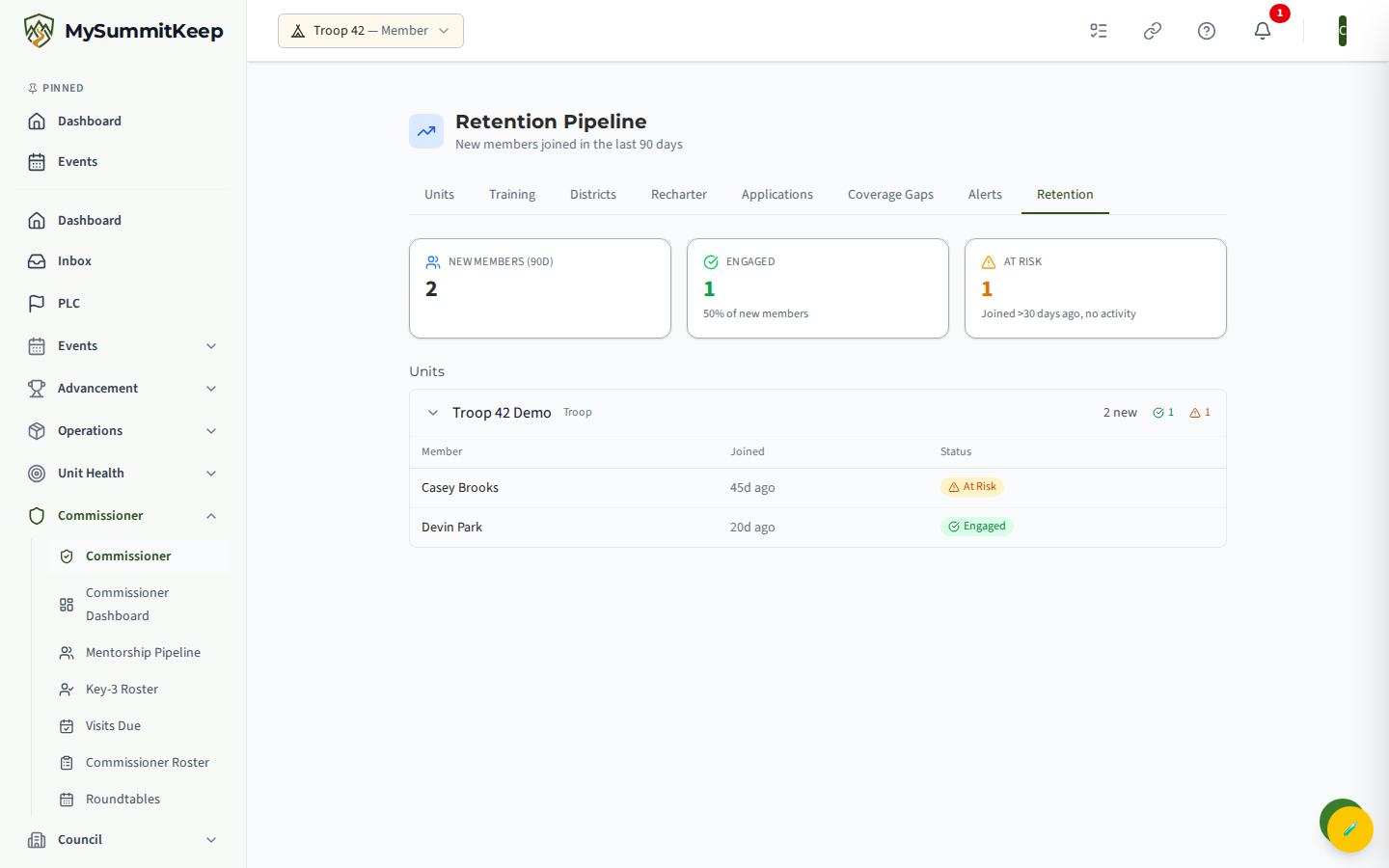
The first 90 days decide whether a new Scout or volunteer sticks around. The Retention Pipeline gathers every member who recently joined a unit you cover and tells you, at a glance, which ones are settling in and which ones have gone quiet — so you can prompt a phone call or a warm welcome before a new family quietly disappears.
Find it under Commissioner → Commissioner Dashboard, then the Retention tab (/commissioner/retention).
This page is about new members in the units you cover. For council-wide retention from one charter year to the next, see Council Analytics.
What the pipeline counts
Section titled “What the pipeline counts”The page looks back over a 90-day lookback window. A member shows up here when they joined one of your units within the last 90 days — specifically, when their unit membership became active in that window. Older members, inactive memberships, and units outside your assigned scope are left out.
The three stat cards across the top summarize the whole window:
- New Members (90d) — the total count of members who joined any of your units in the last 90 days.
- Engaged — how many of those new members are showing signs of life, with the percentage of new members shown underneath.
- At Risk — new members who joined more than 30 days ago with no recorded activity yet.
Engaged vs At Risk
Section titled “Engaged vs At Risk”Every new member is sorted into a status based on real activity in the system, not a guess:
- Engaged (green check) — the member has at least one event registration or a completed advancement recorded within the same 90-day window. That is concrete evidence they are participating.
- At Risk (amber warning) — the member joined more than 30 days ago and has no event registration and no completed advancement on record. Enough time has passed that silence is a real signal.
- New members who joined within the last 30 days but have no activity yet are not flagged At Risk — they are simply still new. They count toward your total but are given the benefit of the doubt while they get oriented.
Expanding a unit to see members
Section titled “Expanding a unit to see members”Below the stat cards, your units are listed with the units carrying the most At Risk members shown first, so the places that need attention rise to the top. Each unit row shows the unit name and type, a running “new” count for that unit, and small green (engaged) and amber (at-risk) tallies.
Click any unit row to expand it. A table opens showing each new member with three columns:
- Member — the member’s name.
- Joined — how long ago they joined, shown as days ago.
- Status — their Engaged or At Risk badge.
Within a unit, At Risk and brand-new members are listed first, then engaged members, each ordered by join date, so the people who most need a nudge are at the top of the list. Click the row again to collapse it.
If no one has joined any of your units in the last 90 days, the page shows a simple “No new members joined in the last 90 days” message — nothing to chase, which is fine.
Using it to drive outreach
Section titled “Using it to drive outreach”The pipeline is a worklist for early intervention. A practical routine:
- Start with the top unit. It has the most At Risk members. Expand it and read the names.
- For each At Risk member, prompt a personal touch. A welcome call from the unit leader, an invitation to the next meeting, or a check-in with the parent. New families rarely leave because of one bad experience — they leave because nobody reached out.
- Look at units with zero engaged. If a whole unit’s new members are all At Risk, that points to an onboarding gap in the unit itself, not just individual families. That is a coaching conversation for the unit’s key three. Log it as part of a commissioner visit.
- Encourage units to record activity. Because engagement is measured from event registrations and completed advancement, units that don’t log those will look worse than they are. Pointing leaders to Member Import, Bulk Invite & Operations, and good Event Planning habits both fixes the data and improves the actual experience.
The Retention Pipeline pairs naturally with Coverage Gaps: coverage tells you which units have a commissioner watching over them, and retention tells you which of those units’ new families need a hand right now.
MySummitKeep is an independent product and is not affiliated with, endorsed by, or sponsored by Scouting America (formerly the Boy Scouts of America). Scouting America, Scouts BSA, Cub Scouts, Venturing, Sea Scouts, and the Order of the Arrow are trademarks of Scouting America. Official program content shown in screenshots and examples is © Scouting America; always confirm current requirements atscouting.org. SeeTerms § 7.3.